
Brandt A. L. Gaches
Astrochemistry | Astrophysics
Emmy Noether Junior Group Leader
University of Duisburg-Essen
High-energy universe, meet the molecular universe

Welcome! I'm a Phoenix native and disabled astronomer living in Duisburg, Germany as an Emmy Noether Junior Group leader at the University of Duisburg-Essen. My research focuses on the acceleration and transport of cosmic rays in molecular clouds, cosmic-ray astrochemistry, and other interactions between high-energy radiation and the molecular interstellar medium. Since September 2026, I have served as an Associate Editor for Astronomy & Astrophysics.
In regions shielded from ultraviolet radiation, the molecular chemistry of the interstellar medium is regulated by energetic, charged particles called cosmic rays. These ionizations and excitations produced by interactions of these particles, dominantly protons, lead to a diverse zoo of molecules. My research focuses primarily on the interactions of cosmic rays with dense, molecular gas and on exploring novel sources of particle acceleration associated with molecular gas and star formation.



Science is funded by coffee.
more coffee, more science!

Research, in brief
-
Relativistic charged particles, so-call cosmic rays, are the primary drivers of chemistry in molecular clouds in regions shielded from intense radiation. Cosmic rays affect molecular gas in numerous ways: charging dust grains, heating gas, and driving chemistry through ionizing molecular hydrogen (and other molecules). Typically, astrochemical models make very simple assumptions about the cosmic ray flux. I am working on implementing more sophisticated treatments of cosmic rays physics into astrochemical models. These cosmic ray-chemistry models provide more sensitive and accurate predictions on the abundances of molecules in star-forming regions.
-
Cosmic rays are produced by accelerating particles, most commonly protons, to significantly higher energies. For proton energies most important for chemistry, between 1 keV and 1 GeV, these particles lose energy rapidly as they travel into molecular clouds. Therefore, novel sources of these low-energy cosmic rays are being searched for! I have explored the acceleration of protons in the enegetic regions near newly forming, accreting stars, called protostars and their impact on chemistry. I have also proposed a novel source of these particles: acceleration in the ubiquitous turbulence within molecular clouds, which would provide a general source available for molecular chemistry.
-
Molecular data for chemical processes is of fundamental importance for astrochemical modelling. The importance of energetic particle interactions on gas- and ice-phase chemistry, from high-energy protons to low-energy electrons, necessitates as much high-fidelity molecular and atomic data for these interactions. I have initiated the Astrochemistry Low-energy electron Cross-Section (ALeCS) database with a collaboration between astronomers and chemists. The initial release includes molecular geometries, electron orbitals and ionization cross sections for over 200 molecules and atoms of astrochemical interest, along with ionization rates in both the UMIST and KIDA formats.
-
Short-lived radioactive nuclei (radionuclides) have half-lives of less than a few million years. Excess amounts of specific radioactive isotopes measured in meteorites indicate the early solar system was contaminated by a wide-range of radionuclides. These isotopes provide fingerprints of the galactic and protostellar environment during the formation of the solar system. Theoretical models typically explain this enrichment by supposing the existence nearby supernova or high-mass stars. I have recently proposed a novel local mechanism of isotope enrichment. My student and I are currently investigating how radioactive isotopes from supernova mix into cold, dense, star-forming gas.

Meet ALeCS, here for you.
The ALeCS database was created by astrochemists, for astrochemists. It has optimized molecular geometries, electron orbitals, electron-impact ionization cross sections, and interstellar ionization rates for over 200 molecules. We’ve thrown in a handful of atoms, too!
The database is living, it will continue to grow as more data is wanted. Whether looking for ionization rates for chemical modeling, electron-impact ionization cross sections for laboratory studies, or anything else that may come to mind, you may be interested in ALeCS.

Recent Research Highlights
3D photo-dissociation regionS with cosmic ray physics
Supernova and winds from stellar clusters are thought to accelerate cosmic rays which permeate the galaxy. As they travel into molecular clouds, they lose energy, forming complex ionization gradients. Astrochemical models typically assume a constant ionization rate. We have produced the first three-dimensional photo-dissociation region models using both an assumed profile of the ionization rate with depth and solving the energy-loss equation from input external spectrum. These models allow us to robustly probe the impact of cosmic ray physics on the emission from key molecules and test and develop calibrators of the ionization rate.

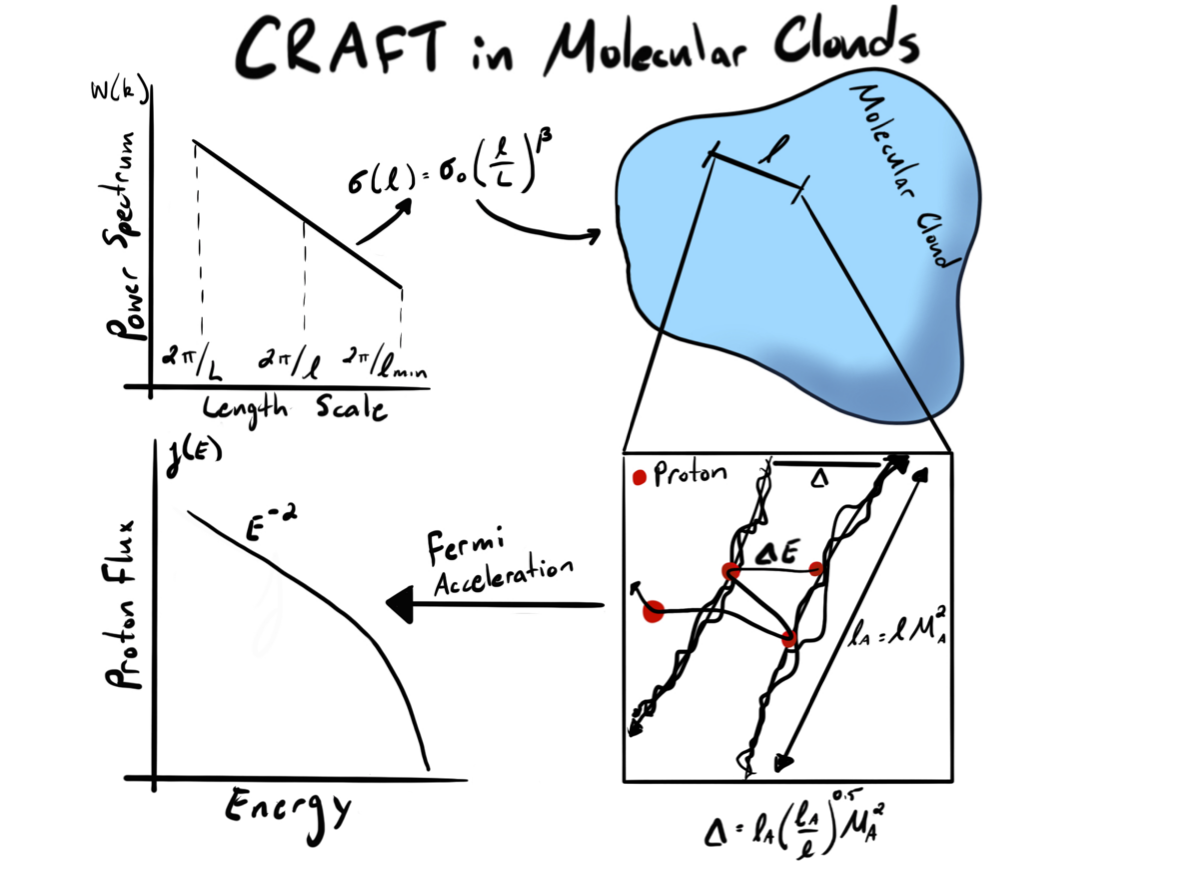
Cosmic rays accelerated by turbulence in molecular clouds
Low-energy cosmic rays are an important source of ionization in the dense gas of molecular clouds. However, they lose energy as they traverse into clouds, so embedded sources may be needed to sustain the observational inferred ionization rates. We have proposed a novel source: acceleration via turbulent magnetic reconnection in the turbulence of molecular clouds. Turbulent reconnection would provide a continuously distributed source within clouds, producing a more uniform ionization rate. Our model reproduces the ionization rates inferred within molecular clouds in local regions and in the galactic center.
HADES: Protostar Accretion at high resolution
Protostars are the embryos of main-sequence stars, still actively accreting and embedded within their natal cores. How these young protostars accrete their mass is still a matter of debate. There is a stark paucity of high-resolution simulations during the stage when most of the mass is accumulated. We have initiated the High-resolution Accretion Disks of embedded protoStars (HADES) simulations, which simulate the accretion at sub-mAU resolutions. The initial suite of simulations will focus on the role of the protostar’s magnetic field for a solar mass protostar.
